

Leaving the UK Doesn’t Necessarily Mean Your UK Tax Position Is Finished
Leaving the UK tax refund is something many people overlook when moving abroad. If you have recently left the UK, or are planning to leave, your final UK tax position may be different from what you expect. PAYE deductions, your P45, UK residence, other income and the timing of your departure can all affect whether you have overpaid tax.
If you’re leaving the UK to live abroad, there is probably a long list of things on your mind.
You may be moving to Dubai, Spain, Australia, the USA, Portugal or another country.
You may have already handed in your notice at work, sold your home, booked your flight and started arranging your new life overseas.
But there is one financial question you shouldn’t overlook:
Have you paid the right amount of UK tax for the tax year in which you leave?
Depending on your circumstances, you may need to consider your UK tax residence position, employment income, PAYE tax already deducted, UK property, pensions, investments and other income.
And in some circumstances, you may be entitled to a repayment of UK Income Tax.
The important point is this:
Don’t assume. Check.
Our Leaving the UK tax checker here https://abandcotaxchecker.co.uk will provide you with your estimated tax refund and things you must consider before leaving the UK to not fall a victim.
Could You Have Paid Too Much PAYE Tax?
Let’s take a simple example.
Imagine you have a UK salary of £50,000.
Your employer deducts Income Tax through PAYE every month.
You then leave the UK halfway through the tax year and move abroad.
You look at your payslips and realise that you have already paid several thousand pounds in Income Tax.
You may naturally ask:
“Have I overpaid tax?”
Possibly.
But you cannot determine the answer simply by looking at your departure date.
Your overall circumstances need to be considered and a detailed calculations done before this can be determined.
Most people leave the UK and forget about the tax refund they could be owed.
If you are leaving the UK for at least one tax year, if you do not complete self assessment already, then completing form P85 correctly will help HMRC to check your tax position and if you are due a tax refund, they will pay it to you. It also informs HMRC that you are leaving the UK.
So the first question isn’t necessarily:
“How much tax can I get back?”
It is:
“What is my actual UK tax position?”
Your P45 Can Be Important
If you leave UK employment pert way through the tax year, your employer will normally provide you with a P45.
Your P45 contains important information about your employment and tax deducted.
HMRC specifically says that you should check your P45 when making a relevant P85 claim and include the appropriate parts where you have one.
But your P45 isn’t necessarily the complete answer.
You may also have:
- UK rental income
- Pension income
- Interest
- Dividends
- Investment income
- A second property
- Capital gains
- Self-employment income
- Other taxable income
All of these can potentially affect your overall tax position.
What If You Don’t Have a P45?
Not everyone has a P45 available when they start looking at their tax position.
For example, you may have left your employment recently and are still waiting for your employer to provide it.
Or your circumstances may mean that a P45 isn’t available.
Relevant information from your final payslip, including year-to-date pay and tax deducted, may still be useful when assessing your position.
This is why it is sensible to keep your final payslip and employment records when leaving the UK.
What About Your UK Residence?
This is where things can become more complicated.
A common assumption is:
“I left the UK on 30 September, so I’m non-resident from 1 October.”
That isn’t necessarily how the UK statutory residence test rules work.
The Statutory Residence Test determines whether you are UK resident or non-UK resident for the tax year, based on the relevant statutory tests and circumstances. HMRC guidance highlights factors including days spent in the UK, family ties, accommodation ties, 90 day tie, work tie, country tie and if you have been UK residence for at least 1 of the previous 3 tax years .
And in certain circumstances, split-year treatment can apply.
What Is Split-Year Treatment?
Split-year treatment can divide a tax year into:
- a UK part, and
- an overseas part.
HMRC’s guidance explains that split-year treatment can apply where specific criteria are met. Split year treatment is extremely important as it could lead to you paying UK tax on your worldwide income and gain in the tax year you leave UK.
There are eight statutory split-year cases, and the relevant conditions need to be considered.
This is important because split-year treatment is not simply something you choose because it produces a better tax result.
If you meet the conditions for a relevant case, the rules determine whether split-year treatment applies.
What If You Keep a UK Rental Property?
Moving abroad doesn’t necessarily end your UK tax obligations.
Suppose you leave the UK but keep a property here that you rent out.
The rental income may continue to have UK tax implications. The rental income and expenses will need to be declared to HMRC each tax year and applicable tax paid.
Similarly, if you later sell UK property, Capital Gains Tax can remain relevant in particular circumstances.
Even if you are a non UK resident, if you sell a UK property, you could own capital gains tax on the gain
This is why someone leaving the UK with a rental property can have a very different tax position from someone who has no UK property.
Don’t Forget Your Pension and Investments
Another common mistake is to concentrate entirely on employment income.
What if you also have:
- A private pension?
- State Pension?
- An ISA?
- Shares?
- Dividends?
- Savings interest?
- Other investments?
Your tax position can depend on the type of income, the asset involved and your residence circumstances.
Therefore, your leaving-the-UK tax position should ideally be considered as a whole rather than by looking at your salary alone.
So, Could You Be Due a Tax Refund?
You might be.
But nobody should promise you a refund simply because you have left the UK.
Your Uk tax position and your result could depend on factors including:
- Your income during the tax year
- PAYE tax already deducted
- If you have paid the right amount of tax up to the date you left the UK
- Your departure circumstances
- Your UK residence position
- Other taxable income
- UK property
- Pension income
- Investments
- Other relevant circumstances
That’s exactly why we developed the AB & Co Leaving UK Tax Checker. Use the link below to check your tax position.
https://abandcotaxchecker.co.uk.
The AB & Co Leaving UK Tax Checker
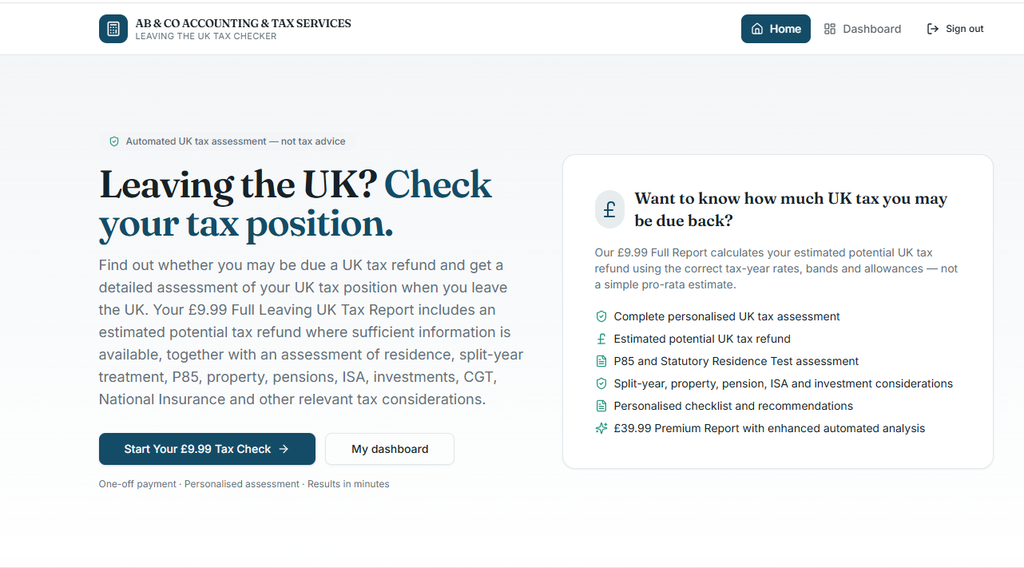
The AB & Co Leaving UK Tax Checker has been designed specifically for people who are leaving the UK or have recently left.
Rather than looking at just one part of your tax position, the assessment takes you through relevant areas of your circumstances.
Depending on your answers, this can include:
Your departure
When and how you left the UK.
Your residence
Information relevant to your UK residence and potential split-year position.
Your employment
Employment income and relevant P45 or final payslip information.
Your tax already deducted
Relevant PAYE information.
Your property
UK property and rental circumstances.
Your pension
Relevant pension information.
Your investments
Relevant ISA, investment, interest and dividend information.
Capital Gains Tax
Relevant asset disposals and circumstances.
National Insurance
Relevant National Insurance information.
Check Your Leaving UK Tax Position
If you’re leaving the UK, or you’ve already left, don’t simply assume that your UK tax position is correct.
Take the time to check it.
Start your AB & Co Leaving UK Tax Check using the link below
AB & Co Leaving UK Tax Checker: https://abandcotaxchecker.co.uk
The assessment is automated and is not a substitute for professional tax advice.
If you require professional advice about your individual circumstances, you should seek appropriate professional advice.
Final Thoughts
Leaving the UK can have significant tax implications.
Your employment, PAYE, residence, home, property, pensions, investments and other income can all form part of the picture.
You may be entitled to a tax repayment.
You may not.
The important thing is to check rather than assume.
Don’t assume. Check.